Freight Rail Electrification
Published: 2026 July
Targeted Electrification for Freight Rail
Autonomie Rail indicates that selective overhead catenary deployment can cut diesel use, improve battery-electric range, and deliver stronger project economics (higher Net Present Value) than minimal electrification coverage.
Study workflow
- Baseline route simulation
Diesel-electric train case over Southern Transcon - High-energy segment screening
Identify 10-mile segments with highest fuel demand - Targeted OCS scenarios
Test 10% to 80% discontinuous electrification as discrete scenarios - Performance and NPV analysis
Compare diesel savings, range, cash flow, and NPV
Why it matters
Full corridor electrification can be effective in reducing the cost of total traction energy required to move trains, but long U.S. freight routes face major infrastructure cost barriers. Targeted electrification offers a more practical path by preserving diesel-electric fleet flexibility while directing investment to high-value segments.
What was analyzed
Argonne simulated advanced locomotive architectures on the BNSF Southern Transcon between Chicago and Los Angeles. A baseline diesel-electric case was used to flag the 10-mile segments with the highest fuel demand, then test discontinuous overhead catenary scenarios from 10% to 80% route coverage.
Key takeaway
Strategically placed discontinuous catenary reduces diesel consumption and extends battery-electric range when trains encountered electrified segments early enough to recharge in motion.
| 20% | 687% | >90% |
|---|---|---|
| electrification coverage scenario outperformed 10% coverage on NPV and diesel savings | range increase for the heavier 2.5 HPT BEL case | trip distance covered by the lighter 4 HPT BEL case |
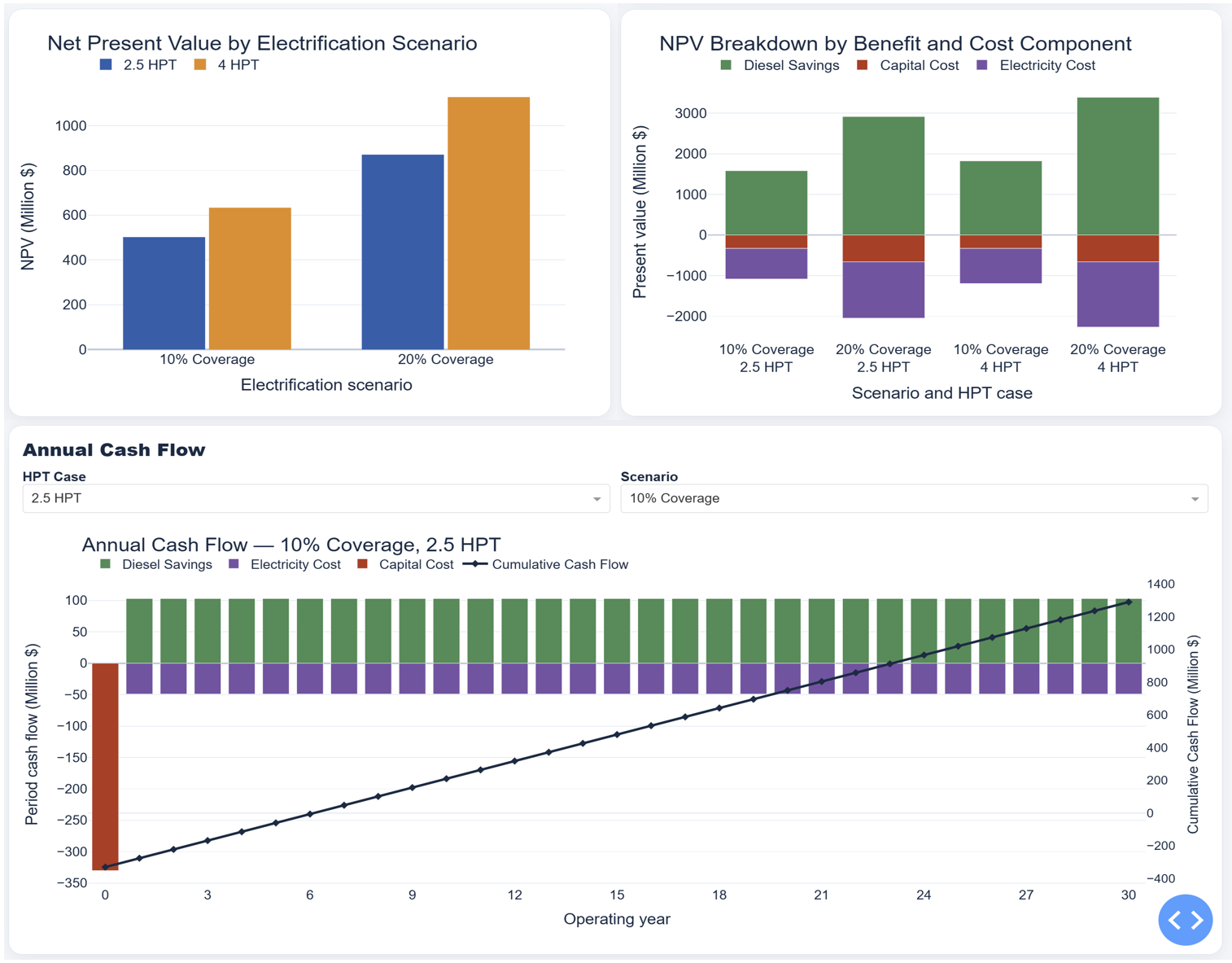 Techno-economic dashboard used to compare diesel savings, net present value, and cash flow under corridor-specific cost and operating assumptions.
Why this matters for deployment
- Targets infrastructure spending to steep grades and other energy-intensive segments instead of electrifying the corridor uniformly.
- Provides a practical example of OCS deployment scenario so that planners can evaluate local electricity price, OCS cost, and traffic assumptions during planning and investment decision making.
- Supports evaluation of dual-mode, hybrid, and battery-electric freight rail pathways in one workflow.